

The Food Delivery Robot's Second Act
A character strategy for sidewalk robots

My last post focused on developing characters for robots that live inside our homes —machines we automatically anthropomorphize. Why? My theory is ownership. They belong to us. So we name them, weave them into our lives, treat them like pets.
However, we do regularly extend a similar sense of “ownership” outward to characters in shared community spaces. Like the neighborhood stray cat. It doesn’t belong to anyone, but exists within our neighborhood, and that creates a sense of guardianship.
I’ve been thinking about how this same dynamic might apply to robots that don’t belong to anyone — machines moving through public space that are often, very literally, in our way. Specifically: the food delivery robots made by companies like Serve Robotics, Coco Robotics, and Starship Technologies — which it’s increasingly common to spot rolling down the sidewalks of urban areas.
How are they currently treated by people they cross paths with? On one hand, social media is full of videos of people lifting them over snowbanks and rescuing them when stuck. College students decorate them and mourn them when retired. On the other hand, people can’t help but mess with them by sticking out a foot or blocking their sensors. I admit that I’ve nudged one myself to see how heavy it was (much heavier than you’d expect). And then there’s the reports of more aggressive vandalism and theft, which carry real costs for these companies in both hardware and downtime.
This conflicting behavior suggests that we haven’t yet decided what these robots are. We’re just past the act one meet-cute. Still sussing each other out. So, below is a thought experiment aimed at resolving the tension through the lens of character and story. Clearly, those designing these robots have already started down the path. They have names. Their front panels resemble faces. But what if we push it further?
Step one is rethinking the delivery robot’s role. Right now, they are selfish characters; taking up precious sidewalk space to transport corporate goods while offering nothing to the people who must dodge out of their way. But what if they got their act two transformational montage and began giving back to the community?
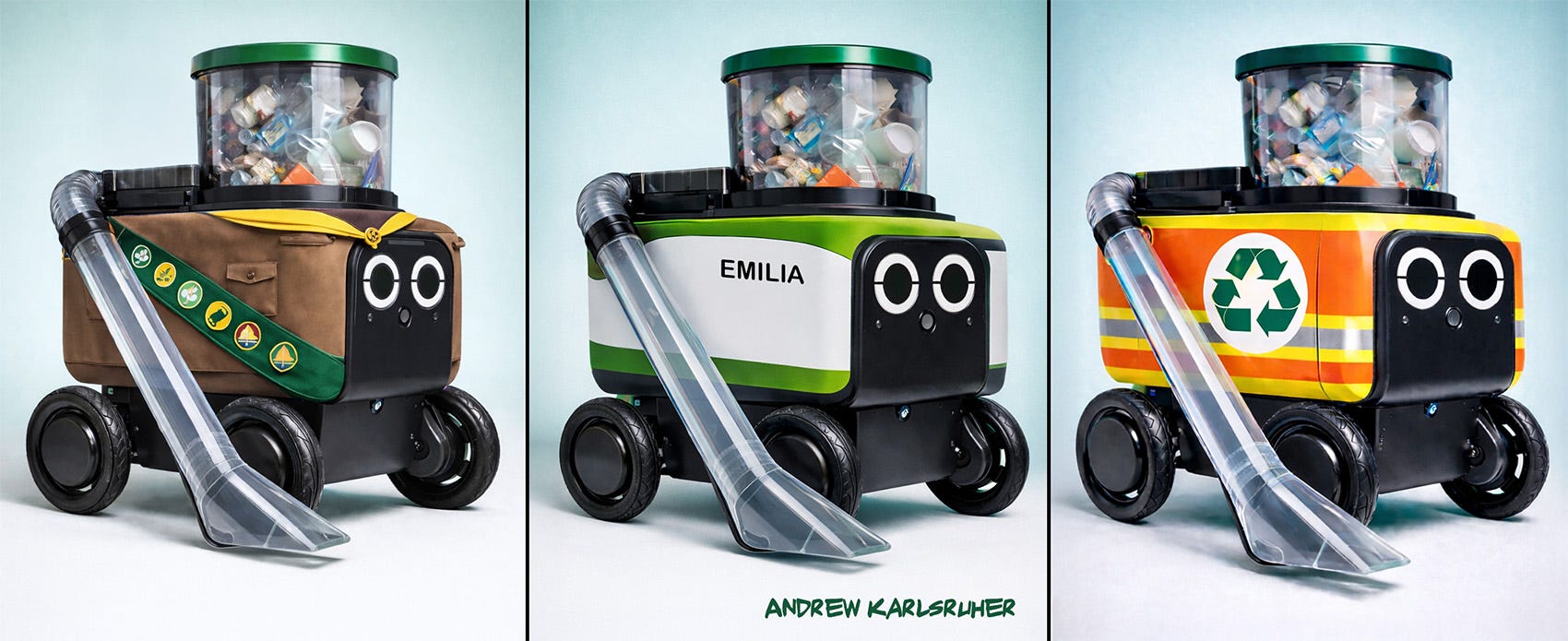
Imagine a robot named EMILIA fitted with a vacuum that collects litter into a transparent canister — visibly displaying the good she’s done — as she travels to her next drop-off. She could be wrapped as a local CUB SCOUT or SANITATION WORKER, on a mission to help, reinforced by a chipper tone: “Cleaning up while I cruise! Don’t mind me, just debugging the sidewalk.” (Yes, I realize the LIDAR hardware didn't make it into the above renderings. My apologies. V2 problem.)
Admittedly, managing litter cleanup AND food delivery could prove too complex and costly for companies already wrestling with the immense challenges of deploying these machines. But even introducing one into the fleet that does nothing but pick up trash — rotating between neighborhoods around the city — could extend goodwill to the entire system. A “day in the life of Emilia” social campaign — documenting her sidewalk cleanups — would spread the good vibes to her kind worldwide.
These optics matter more than it might seem at first glance. Sidewalk robots are heavily regulated city by city. Public officials concerned with liability, wheelchair accessibility, and pedestrian safety are in charge of granting and revoking operating permits and seriously consider public sentiment. So, a character-forward robot that generates genuine community affection by giving back isn’t just great PR — it actually protects the company’s license to operate. So, now the big question: what would it cost? Maybe nothing. Maybe someone else would even pay for the privilege.
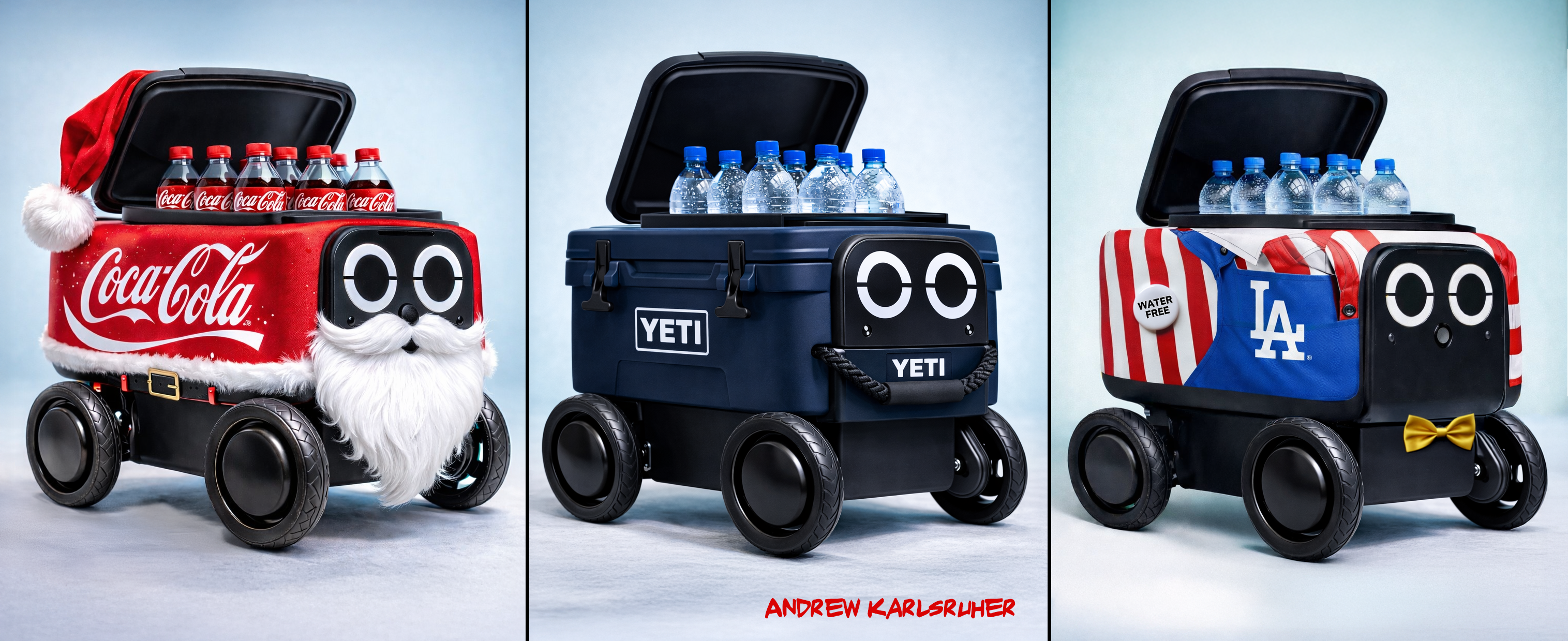
Imagine one of these robots, using existing hardware, popping open its compartment to offer water on a hot day — its wardrobe, voice, and tone fully aligned with a sponsoring brand. Like a YETI COOLER robot exclaiming, “Hydration station rolling through.” Or a BALLPARK VENDOR sent to your neighborhood by the L.A. Dodgers on game day, “Cold water! Ice cold! Get your water right here!” Or, in December, a SANTA CLAUS robot chuckling, “Ho ho ho, no sleigh today, just these wheels. Grab a Coke.”
Some companies are already starting down this path. The best example so far: Serve Robotics wrapped one of their robots in Tostitos branding during Super Bowl weekend — with NFL quarterback Brock Purdy talking through it in real time. It was fun. People noticed and shared. But a wrap is still received like a rolling billboard. If these companies leaned all the way into the characters they’ve already introduced and anthropomorphized, a media placement becomes a relationship.
For most people, the first "robotic character" in their lives won't be in an office or in their home. It'll be the one rolling toward them on a sidewalk delivering burritos. Behold: humanity's first contact. Right now they are fun novelties or ignored at best, nuisances at worst. But once character earns these machines their place in the community, branded or not, the social contract shifts. Now they belong to all of us. Suddenly, blocking the robot's sensors doesn't feel like teasing a machine. It feels like bullying a civic servant. Or messing with the neighborhood stray cat.
And that's just mean.