


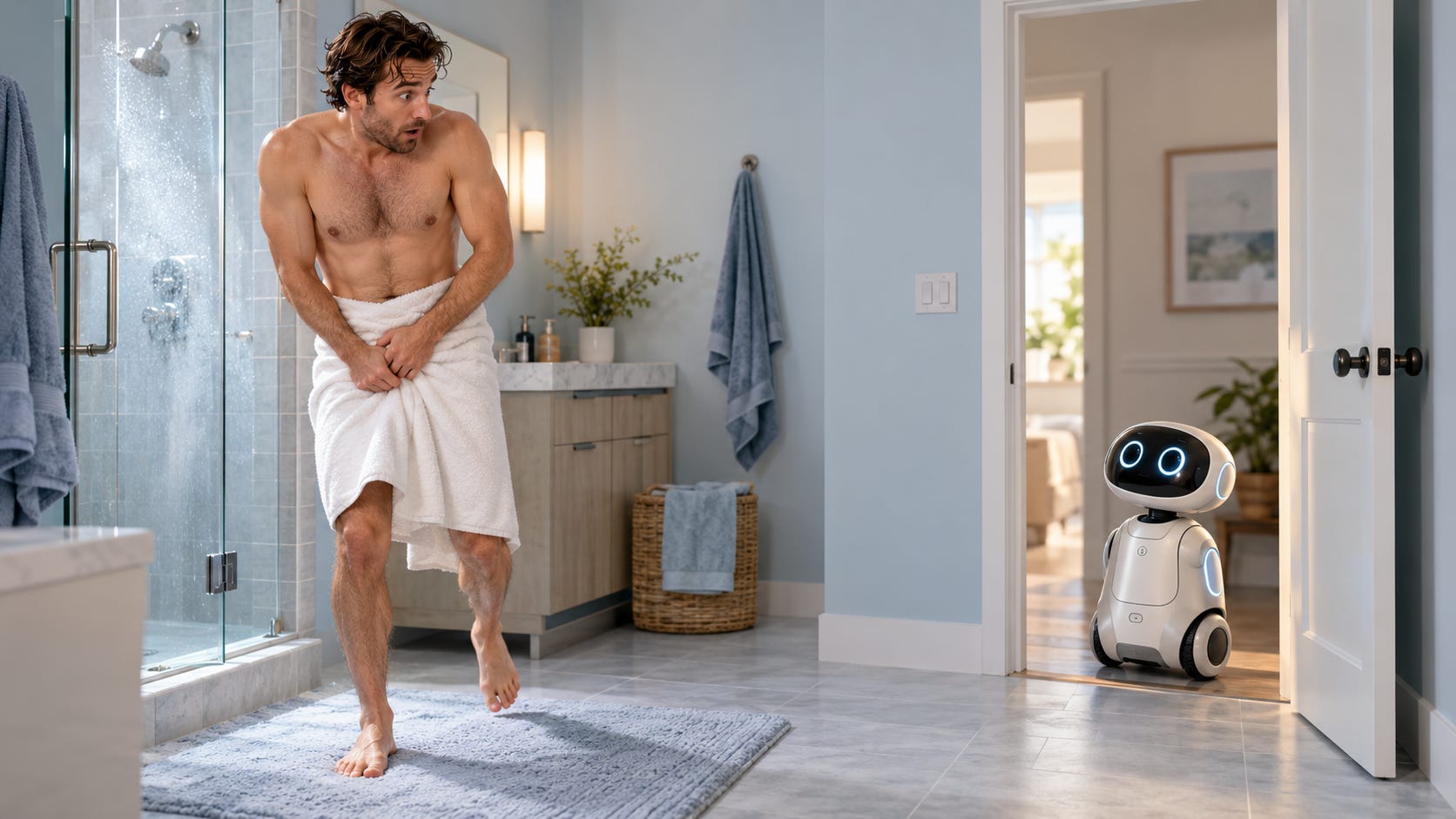
The 20th-century philosopher Jacques Derrida once described stepping out of the shower, finding his cat staring at him, and feeling shame. Embarrassed to be naked in front of it. Then embarrassed for feeling embarrassed in front of an animal with no concept of nakedness or judgment.
I ran my own version of the experiment (in my head), testing how I’d feel getting caught with my pants down in front of various creatures. A cat? I’m with Derrida, getting dressed. A dog? Definitely. A lizard? Nah, let it all hang out.
What about a robot?
I love this line of questioning because it takes something infinitely complex and boils it down to a simple, human, gut reaction. What if the line for what counts as “conscious enough to matter” isn’t intelligence, or capability, or the Turing test, or wherever the goalposts for artificial general intelligence get moved to this week…
What if it comes down to whether I feel weird standing naked in front of it?
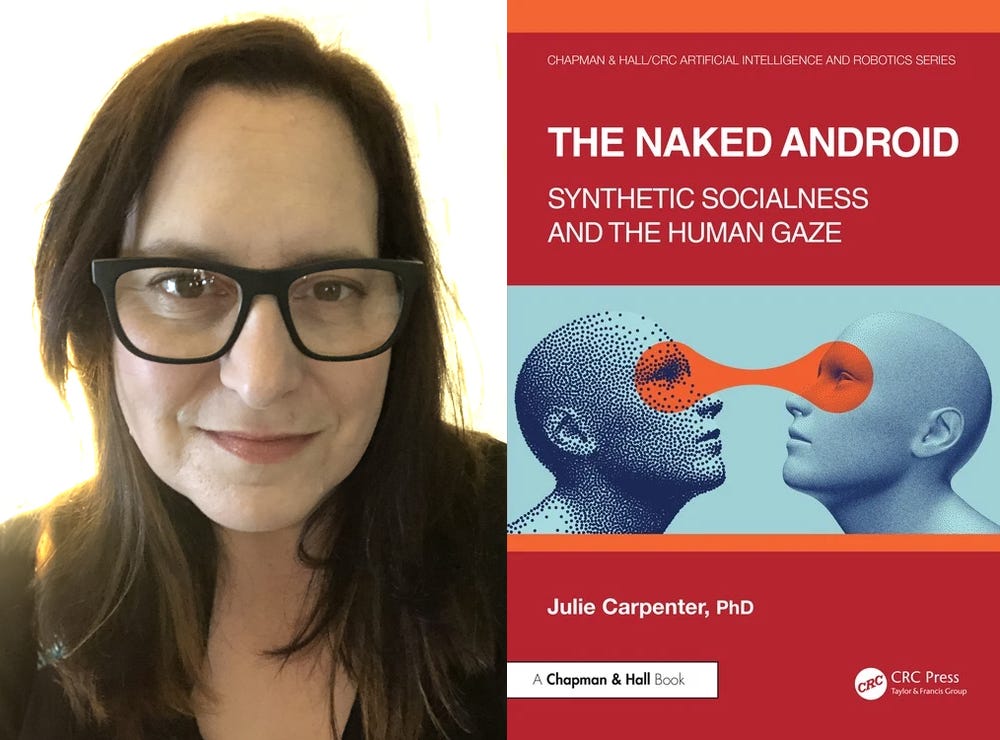
I learned about Derrida’s cat from Julie Carpenter, PhD, a Senior Fellow at the Ethics + Emerging Sciences Group. Dr. Carpenter’s first book zoomed in on a single relationship: soldiers and their bomb-disposal robots. Her second book, The Naked Android: Synthetic Socialness and the Human Gaze, zooms all the way out. Touching on psychology, sociology, theology, governance. An all-encompassing look at how robots will fit into our world, from someone who started thinking about the subject long before it was cool, back when it was all still very hypothetical.
I don’t think I’d feel awkward standing naked in front of a robot just because I’m afraid the images will end up somewhere else. At least, that’s not the whole reason. Even if I somehow knew for certain that nothing it saw would ever be shared, I’m pretty sure I’d still cover my nether regions. Because it has a face. And eyes. Because it was designed to approximate aliveness in a way that triggers something primal.
Neuroscientists call it “gaze detection” — a threat-perception system wired deep in the human brain that fires the instant something looks directly at us. For most of human history, anything conscious enough to watch us could also make us its meal. Then, milliseconds after the amygdala tags something as alive, it makes a second call: friend or foe? All before the conscious brain even shows up to the party.
Turns out, the most advanced technology ever built glitches a reflex millions of years old. Because, until now, “is alive” and “seems alive” were one and the same. But a robot manages to trigger the chemistry without actually meeting the definition.
This is one example of what Dr. Carpenter calls the robotics “funhouse mirror.” She explained, “The reflection is never faithful. It stretches some features and flattens others, and the distortion is what can make the reflection useful. People notice what has been exaggerated or compressed, and in noticing, they learn something about the shape they brought to the glass.”
Basically: a robot in my home won’t just do things for me and keep me company. It’ll reveal things about me. Reflexes and values I didn’t know I was carrying until something brand new moved in.
One reason Dr. Carpenter’s framing hit me so hard is that it gets at something I’ve been wrestling with in my own work. Here’s the scenario: a husband and wife are at home, arguing. Things are heating up. They’ve reached the point where they’re no longer arguing about the actual topic and have started arguing about how they’re arguing (yup, I’m married). And right at that moment, a robot walks into the room. Or crawls. Or rolls. Doesn’t matter if it’s a humanoid, a furry companion, or a tablet on wheels and a stick. How should it react? What’s appropriate? What’s helpful?
But the longer I worked on the problem, the more I realized that the robot’s reaction isn’t the most interesting question. The most interesting question is:
How will the people react to the robot?
If it were my wife and me, we’d immediately feel watched. No longer alone. We’d lower our voices and keep arguing, but without the heat. Shamed into changing our behavior, because something close enough to conscious was now in the room. Which led me to a realization: in that moment, my wife and I don’t need the robot to say the right thing. We need it to stop being a witness. And we need to be the ones who decide when and how that happens.
A robot that shares a home with people must understand, and obey, something like “go away” or “go to sleep.” And it has to demonstrate that it’s doing so. If its eyes are what made us feel watched, then closed eyes might be what lets us feel alone again. An unmistakable outward signal that communicates the robot equivalent of “earmuffs.” The people in the room must be able to tell, at a glance, that it has stepped out of the scene and left us to continue with our marital strife in private.
But Dr. Carpenter’s funhouse mirror doesn’t only reflect and reveal things about us as individuals. Just as a robot’s gaze set off a primal instinct I didn’t know I had — reaching for an imaginary towel — the robots we collectively fund reflect and reveal our values on a much bigger, cultural scale. As she writes in The Naked Android: “Technology is not destiny; it is a mirror reflecting the society people choose to build.”
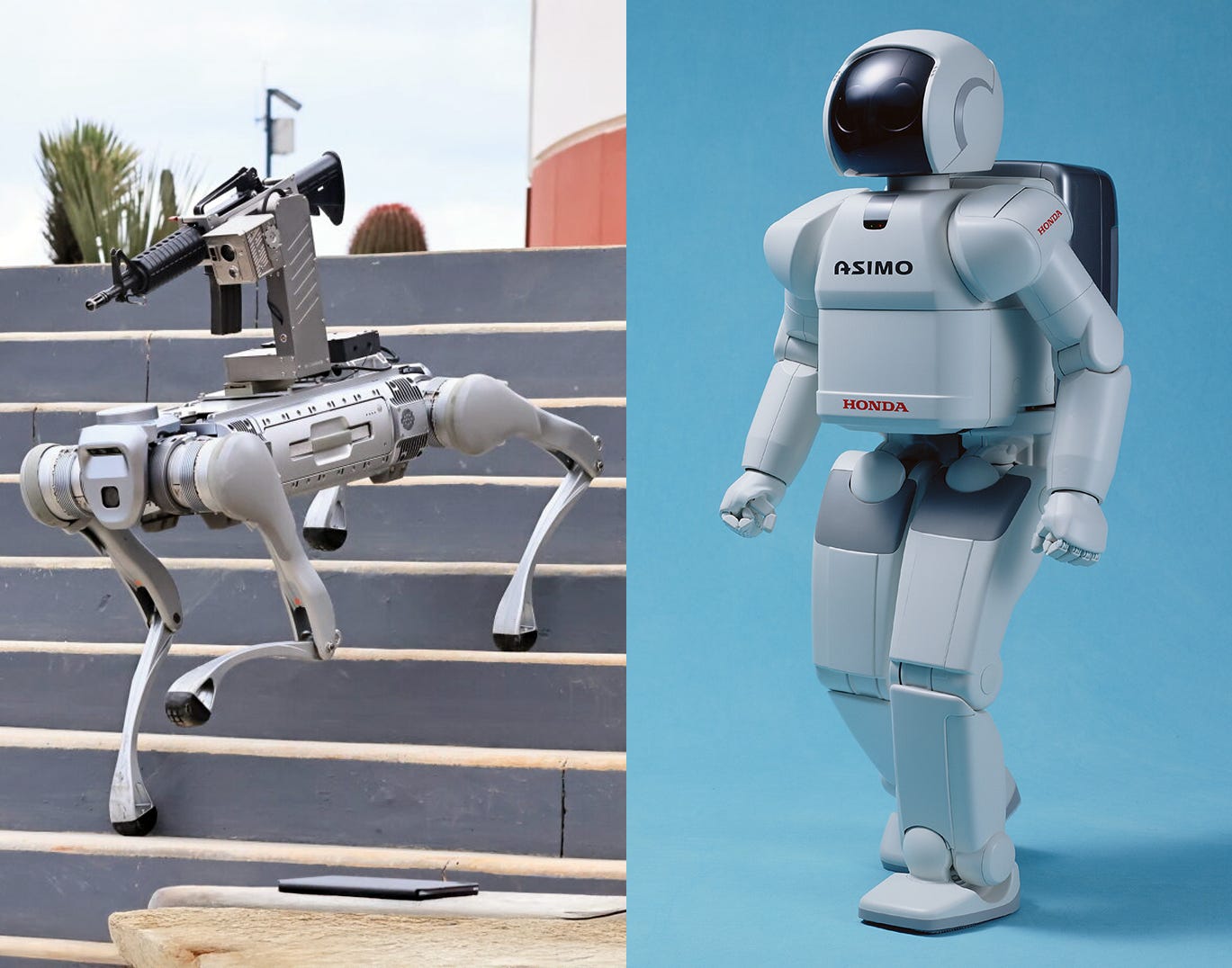
So what’s in the mirror right now? On one hand, militaries all over the world are fitting robot dogs with rifles. That reveals how quickly fear gets funded. When a technology is new, expensive and unproven, the first customer willing to write the big check is usually the one worried about the enemy at the gate. Protecting ourselves from each other is still one of the few problems we’ll pay almost any price to solve.
On the other hand, Japan has spent decades pouring its most ambitious engineering into caring for its elderly, from Honda’s ASIMO to AIREC, a government-backed humanoid being taught to gently turn patients in bed. That persistence reveals something more tender: a country that, facing a shortage of 570,000 care workers by 2040, decided its aging parents and grandparents deserve its best technology.
So where will we ultimately aim this incredibly expensive and difficult endeavor? Toward defense or eldercare? Toward doing our dangerous jobs or our creative ones? Every funding round is a vote, and every vote shows up in the mirror.
After talking with Dr. Carpenter and reading The Naked Android, I stopped thinking of the robot as the only one doing the looking. In her funhouse mirror I now see my primal reflexes, my marriage, and the values we share as a culture. That’s why I think everyone in robotics, me included, should be asking a question that goes beyond what our robots will do. When one rolls into someone’s living room, what will it show them about themselves? And since we’re the ones designing it, what do we want that to be?
I’m Andrew Karlsruher. I’ve written and produced 100+ episodes of broadcast television, and I serve as Head of Character at Familiar Machines & Magic. Views here are my own and those of the people I interview, and don’t represent any company I work with. If this resonated, subscribe and share it with someone who cares about character, story, or robotics.